Surface finishing
For aluminum & zamak die casting products, there are so many surface finishing suit for them:
A, Powder coat
B, Painting
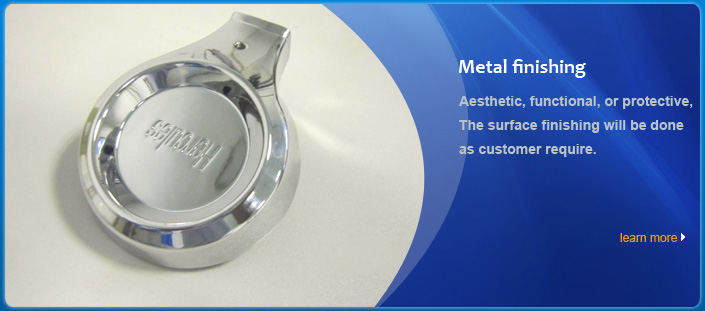
C, Chrome
D, E-coat
E, Anodize
and etc. That depends on our customers' require
Informations for refer to
- Powder Coat / Painting
Powder paint is an environmentally safe alternative to solvent based wet paints since there are no VOC's. In addition, powder offers many advantages over wet paint. The finish is consistent and free of runs, drips and sags.
Powder paint is negatively charged by the gun applicator as it is sprayed. It adheres to the grounded metal (ferrous or non-ferrous) part to be coated. The part is then cured in an oven. As the powder loses its charge in the oven, it begins to melt to the substrate. Normal film build ranges from 1.5 to 5 MILS. However, thicknesses outside this range is attainable if needed.
- Chrome
Cast Specialties, Inc. is dedicated to meeting or exceeding the high quality standards set by our customers. Quality levels are established for each job based on the application requirements. Each lot of incoming materials are certified and quality inspections are made at programmed intervals during our production process.
Chrome plating is a finishing treatment utilizing the electrolytic deposition of chromium. The most common form of chrome plating is the thin, decorative bright chrome, which is typically a 10 μm layer over an underlying polished nickel plate. Thicker deposits, up to 1000 μm, are called hard chrome plating and are used in industrial equipment to reduce friction and wear and to restore the dimensions of equipment that has experienced wear.
- E-coat
E-coat is an emulsion of organic resins and de-ionized water, which is in a stable condition. The e-coat solution also comprises of some solvent and some ionic components. When a D.C. voltage is applied across two immersed electrodes, the passage of current is accompanied by electrolysis of water. This results in oxygen gas being liberated at the anode (positive electrode) and hydrogen gas liberated at the cathode (negative electrode). The liberation of these gases disturbs the hydrogen ion equilibrium in the water immediately surrounding the electrodes. This results in a corresponding pH change and this in turn de-stabilizes the paint components of the solution and they coagulate onto the appropriate electrode.
- Anodize
Anodizing is an electrochemical process that converts the metal surface into a decorative, durable, corrosion-resistant, anodic oxide finish. Aluminum is ideally suited to anodizing, although other nonferrous metals, such as magnesium and titanium, also can be anodized.
The anodic oxide structure originates from the aluminum substrate and is composed entirely of aluminum oxide. This aluminum oxide is not applied to the surface like paint or plating, but is fully integrated with the underlying aluminum substrate, so it cannot chip or peel. It has a highly ordered, porous structure that allows for secondary processes such as coloring and sealing.
Anodizing is accomplished by immersing the aluminum into an acid electrolyte bath and passing an electric current through the medium. A cathode is mounted to the inside of the anodizing tank; the aluminum acts as an anode, so that oxygen ions are released from the electrolyte to combine with the aluminum atoms at the surface of the part being anodized. Anodizing is, therefore, a matter of highly controlled oxidation—the enhancement of a naturally occurring phenomenon.
TEL:(86-769)-86249838 FAX:(86-769)-86249978 Guangdong ICP:16129400号 网站备案/许可证号:粤ICP备16129400号